Articles Posted in Multidistrict Litigation

IVC Filter Which Has Migrated to the Heart

In this post we look at the history of C.R. Bard’s problematic IVC filters, which sadly have caused many injuries and several deaths. In May 2015 a multidistrict litigation site (MDL) was selected for claims across the country arising from injuries relating to C.R. Bard’s “G2 Series” and “Recovery” IVC filters. But before we get to the Bard MDL, however, we have to ask, “well, how did we get here?”

Bard Recovery IVC Filter

In 2002 C.R. Bard received approval from the FDA to market the Recovery IVC filter. The Recovery received approval for marketing under the dreaded 510(k) approval process, which I have written about often. Soon after the release of the Recovery filter, reports of injuries and deaths began to occur. The primary issues were that the Recovery filter moved (doctors call it “migration”) and broke apart much more often than other IVC filters on the market. After many of these alarming results, C.R. Bard arranged for a study to be performed on the Recovery filter, and this study, published in December 2004, concluded that the Recovery filter created a significantly higher risk of injury and death in patients compared to other IVC filters available to physicians and patients. The report qualified its findings by noting that given the “flaws in the data” (whatever that is) it cannot say conclusively that the Recovery filter presents an “excess risk”; the report nevertheless concluded that further investigation is “urgently warranted.”

Despite this dire warning, C.R. Bard continued to sell the Recovery filter. It finally discontinued the Recovery in 2005.  But this action was too late: as many as 20,000 people still have the Recovery IVC filter implanted in their bodies to this day.

Bard G2 and G2 Express IVC Filters

In 2005 C. R. Bard introduced the G2 IVC filter. That same year C.R. Bard circulated an internal memo in December 2005 expressing concerns with the safety and functionality of the G2 filter. The Bard Memorandum noted that the G2, much like the Recovery filter, had problems with perforation, tilting, and moving. Despite this information, C.R. Bard kept selling the G2 filter. In 2008, as part of the G2 Series, Bard introduced the G2 Express, which has also been found to move, tilt, migrate, and break apart.

Continue reading

Inferior Vena Cava Filter

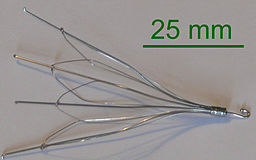
I have to say, this one looks a little terrifying. Check out the photo to the right. This is an IVC filter. As with most things, when you first learn what the object is and what it is intended to be used for, you should think “Brilliant! What took so long to invent this thing?” The problem is, the IVC filter can move, turn, or break apart inside a blood vessel, causing all kinds of problems, including death of the patient. So let’s take a look at the product and the lawsuits that have resulted from the medical device.

What Is IVC?

IVC is the acronym for “inferior vena cava,” which is the primary vein running from your lower body to your heart and which carries deoxygenated blood. (And just for completeness, the superior vena cava is the large vein carrying deoxygenated blood from the upper body to the heart.) The vena cava veins move this deoxygenated blood into the right atrium of the heart, where it can be oxygenated and sent back out into the body. Obviously the IVC is a vitally important vein inside the body, and when problems occur they can become serious and even life-threatening.

Continue reading

Depuy Pinnacle Trial in Dallas, Texas

There is a very important Depuy Pinnacle hip case being tried in Dallas, Texas as I write this.

The federal court system has consolidated many of the Depuy Pinnacle lawsuits into one multidistrict litigation in the North District of Texas (3:11-md-02244) presided over by federal judge Ed Kinkeade.

Bellwether Cases

Back in August, Judge Kinkeade selected certain cases as “bellwether selections” and ordered the parties to organize those cases for jury trials.  Bellwether cases are representative cases which have broad characteristics in common with many of the remaining cases.

So Judge Kinkeade ordered that five separate cases would be consolidated into one (very large) jury trial, to start January 8.  Those five plaintiffs are:

  • Aoki
  • Christopher
  • Greer
  • Klusmann
  • Peterson

One jury will hear all the evidence in these cases, but the judge will allow the jury to consider liability in each case, and to award separate damages in each case.  Based on court filings, all five plaintiffs are from Texas, and each case has many similarities, thus making them amenable to trying together.  In the language of the law, these five cases have “common issues of law and fact.”  Opening arguments began January 11.  The case is supposed to last three months.

Continue reading

Artificial Knee Failure

“The Most Anatomically Accurate Knee Implant”

In 2012, medical device manufacturer Zimmer, Inc. introduced the Persona artificial knee to the public with lofty language.  Zimmer announced that the company was “redefining knee arthroplasty and ushering in a new era of personalization with the introduction of the Persona Knee.” Zimmer stated on its website that by “working with more than 50 of the world’s most respected orthopaedic surgeons, and utilizing analytics from both genders and 1,500 different bone types from 26 different ethnicities, Zimmer was able to create the most anatomically accurate knee implant.”

The reported advantage of the Persona knee system, according to Zimmer, was that it would give surgeons several component options for each patient and each surgery, thus assuring a tailored fit for the patient.  Again, from Zimmer: “the result is an implant system that addresses the unique needs of the patient and accommodates surgeon-specific preferences — all while empowering surgeons to minimize “trade-offs” and better optimize results.”  Sounds great, doesn’t it?

Zimmer sold the Persona knee from November 2012 through March 2015.  A lot of them.  But bad things began to happen.  People began reporting pain and other symptoms, including loosening of the knee components inside the leg.

Continue reading

I’ve written a lot about the Depuy ASR Hip System on this site.  And there are good reasons for that.  First, I have represented many clients who suffered from failed Depuy ASR hip components, so I’ve spent a lot of time in the Depuy ASR MDL.  Second, the Depuy ASR hip failures have generated thousands of lawsuits across the country, more than other artificial hip products.  The last I checked, filed cases involving the Depuy ASR hip system exceeded 10,000, so the ASR claims are far and away the biggest source of litigation among the artificial hip manufacturers.

Nevertheless, other artificial hips have been failing.  Depuy Orthopaedics manufactures and sells the Depuy Pinnacle Cup System.  Thousands of lawsuits have been filed against Depuy and Johnson & Johnson related to the Depuy Pinnacle hip, although so far, Depuy is defending the Pinnacle Hip aggressively and recently won a jury trial involving a woman who claimed she was injured by the Pinnacle.

Surgeon Reviewing X-Rays of Depuy Pinnacle Artificial Hip

Continue reading

Testosterone Lawsuits in Chicago Illinois

So you are a man in your early fifties, and around four years ago you were prescribed testosterone to treat what you were told was “Low-T” (or low testosterone–I’ve already written on this subject). Sadly, two years ago you suffered a pretty awful heart attack, and your doctor took you off the testosterone replacement therapy and stated that he believed the testosterone was a significant cause of your heart attack. Four months later you found a good attorney who agreed to review your case, and six months after that your attorney filed suit in federal court in Raleigh, North Carolina. So far so good (well, except for the heart attack). Then two months later you discovered that your case had been “transferred” to federal court in the North District of Illinois in Chicago.

So What Just Happened?

Your case was transferred from your home federal district court to the multidistrict litigation (“MDL”) court that has been designated to consolidate cases like yours in one central court with one primary federal judge as a way to process more efficiently the hundreds of claims against the testosterone manufacturers.

For testosterone lawsuits such as yours, that MDL is “MDL 2545 (In re Testosterone Replacement Therapy Products Liability Litigation).” Judge Matthew F. Kennelly is the presiding federal judge of MDL 2545.

Continue reading

I am pleased to present my new ebook, Artificial Hip Lawsuits: What You Need to Know.

Artificial Hip Lawsuits: What You Need to Know
For now I am making the book available for free in digital format; simply click the link on the right and download your copy of the book.  We can also send you a printed copy if you like–simply reach out to us using the contact box on the right.

Nine years ago I was hired to represent a woman who suffered terrible pain and misery after her artificial hip failed. Since then I have helped many others who have had traumatic experiences following a failed hip replacement surgery. I hope this book may help you.

Couple reviewing Depuy ASR hip settlement offer
In Part 1, we began to look at some of the factors you should consider before you decide to accept a settlement from Depuy or not. Now let’s dig a little deeper . . .

Two Recent Depuy ASR Jury Verdicts

As the Depuy ASR Hip Settlement was being negotiated, two cases involving the alleged failure of the Depuy ASR hip were tried to a jury, one in Los Angeles and one in Chicago. In Los Angeles, a jury awarded $8,338,000.00 to Loren Kransky, who suffered from extremely high metal levels in his blood (the jury awarded $338,000 in medical expenses and $8,000,000 in pain and suffering damages but did not award punitive damages). In Chicago several weeks after the Kransky trial, a jury found that Depuy was not negligent and that the injury to Carol Strum was more likely caused by her unique health issues, particularly her sensitivity to elevated metal levels in the blood. In the Chicago case, therefore, Ms. Strum received no money at all.

Artificial Hip Multidistrict Litigation
All right, today we drill down a bit on a rather tedious subject:  civil procedure.  I need to explain how your artificial hip case may start in your local state court or nearby federal court but then wind up in a federal court hundreds of miles away. It may seem random and chaotic, but with the rise in the number of failed medical devices like artificial hips, multidistrict litigation is an efficient and useful way to process thousands of lawsuits against a medical device manufacturer.

What is Multidistrict Litigation?

When a large number of products liability cases are filed in courts all over the country, all of which involve the failure of a single product, and which has caused similar injury to many individuals, a single court may be chosen to consolidate the cases into one “multidistrict litigation” (“MDL”). From this one court the designated federal judge will manage the discovery, hear motions, resolve pre-trial issues, possibly preside over bellwether trials, and even monitor global settlement discussion.

Client Reviews
★★★★★
I was involved in a case for the faulty hip replacements. Clay Hodges represented me. I can't say enough about how much he has helped me. Clay was able to win multiple settlements on my behalf with most of them being the maximum amount able to be awarded. Matt J.
★★★★★
Clay, thank you sir for making a disheartening experience at least palatable, you and your staff were honest, caring and understanding through the entire process of my wife’s hip replacements, while monetary settlements never make the pain and suffering end, it sometimes is the only way people can fight back to right a wrong. J. V.
★★★★★
We are absolutely pleased with how Clay Hodges handled my husband’s hip replacement claim. He always kept us informed of the progress. And, his work resulted in a settlement which we are extremely pleased. Thank you, Clay! Carol L. & Norm L.
Contact Information